



RollSculpt 8D Compression Roller System: Technical Overview of a Mechanically Driven Non-Invasive Body Contouring Platform
Abstract
The RollSculpt 8D Compression Roller System is a professional-grade mechanical therapy device designed for non-invasive subcutaneous tissue manipulation, targeting cellulite, localized adiposity, lymphatic stasis, and skin laxity. This article provides a detailed technical analysis of the system’s architecture, core operating principles, mechanical design, control electronics, and clinical-grade safety engineering, emphasizing its precision-engineered components and evidence-based therapeutic mechanisms for aesthetic and wellness applications.
1. System Architecture & Hardware Design
The RollSculpt platform is built on a modular, dual-handpiece architecture, consisting of a main control unit and two specialized electromechanical applicators, optimized for distinct tissue interaction profiles.
1.1 Main Control Unit
The control unit houses the system’s power management, motor drivers, and user interface, with the following key specifications:
- Processing & Control: orchestrates real-time communication between the touchscreen UI, motor drivers, and handpiece sensors, executing closed-loop control algorithms for speed, pressure, and vibration regulation.
- User Interface: An capacitive LED touchscreen provides parameter configuration (intensity, session duration, mode selection) and system diagnostics. The UI displays real-time feedback on handpiece speed, cycle count, and operational temperature, with built-in firmware for firmware updates and usage logging.
- Power & Thermal Management: The unit features a universal AC-DC power supply (110–240V, 50/60Hz) with isolated circuitry to prevent electrical interference. An active air-cooling system with variable-speed fans maintains internal component temperatures below 45°C during continuous operation, ensuring thermal stability for extended sessions (up to 8 hours).
- Safety Interlocks: Hardware-level overcurrent, overvoltage, and overtemperature protection circuits trigger automatic shutoff if operational parameters exceed predefined thresholds, preventing component failure or thermal damage.
1.2 Dual Handpiece Mechanical Design
Each handpiece integrates precision-machined components to deliver controlled mechanical stimulation, with design variations tailored to tissue depth and sensitivity:
1.2.1 High-Torque Body Applicator (Large Handpiece)
- Drive Mechanism: A brushless DC motor (rated 15W, 24V) with a planetary gearbox delivers variable rotational speeds (410–450 RPM) with torque output up to 0.35 N·m, optimized for deep subcutaneous tissue manipulation.
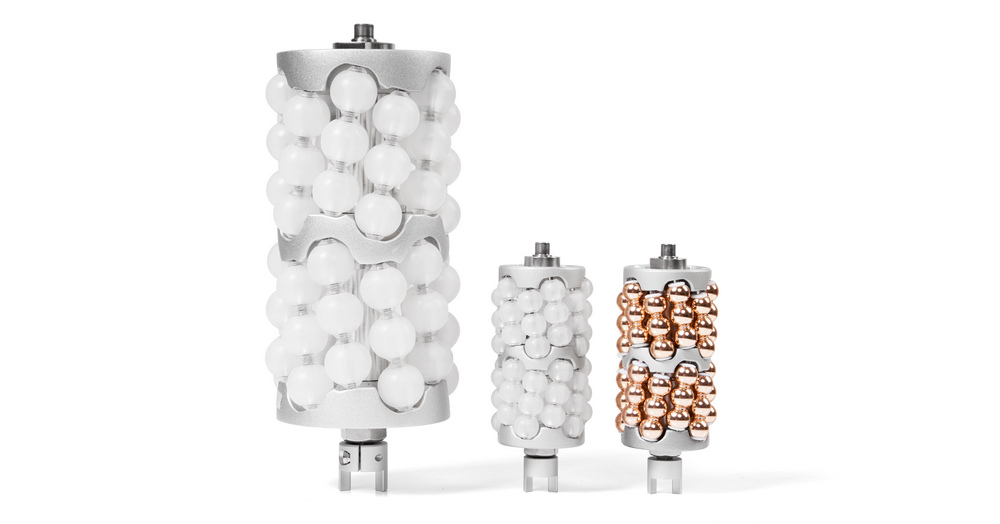
- Roller Assembly: The applicator head contains a medical-grade silicone spheres (12mm diameter) mounted on stainless steel shafts, arranged in a helical pattern to generate a 360° compression-kneading motion. The spheres are coated with a low-friction, hypoallergenic silicone layer (Shore A 45 hardness) to minimize skin shear while maintaining sufficient grip for tissue engagement.
- Feedback Sensors: A pressure-sensitive strain gauge integrated into the handpiece housing measures contact force (0–50N) and transmits data to the MCU, enabling adaptive speed adjustment to prevent excessive tissue compression.
1.2.2 Precision Facial Applicator (Small Handpiece)
- Miniaturized Drive System: A compact brushless motor (8W, 12V) with micro-gear reduction delivers controlled speeds (300–380 RPM) with reduced torque (0.18 N·m), suitable for delicate facial and cervical tissue.
- Micro-Roller Configuration: The applicator head features a matrix of smaller silicone spheres (8mm diameter, Shore A 35 hardness) with a reduced pitch to minimize tissue displacement, targeting superficial layers (dermal and subcutaneous) without compromising vascular or neural structures.
- Ergonomic & Thermal Design: The handpiece incorporates a passive heat sink in the handle to dissipate motor-generated heat, maintaining surface temperatures below 40°C during operation to prevent thermal discomfort.
2. Core Operating Principles: Microvibration Mechanism
The RollSculpt system’s therapeutic efficacy is derived from the synergistic interaction of three mechanical phenomena, engineered to modulate subcutaneous tissue physiology at multiple depths:
2.1 Rotational Compression & Shear Stress
The helical roller configuration generates cyclic, sinusoidal compression (0.2–0.8 bar) and tangential shear stress (5–15 kPa) as the spheres traverse the skin surface. This mechanical stimulation disrupts the fibrous septae that anchor subcutaneous fat lobules, the primary structural component of cellulite, by inducing controlled micro-tearing of collagen fibers. Over multiple sessions, the body’s natural wound-healing response remodels these septae, reducing the “orange peel” topography.
2.2 Rhythmic Lymphatic Pumping
The system’s pulsation mode (variable cycle frequency: 1–3 Hz) mimics the rhythmic contraction of lymphatic vessels, generating pressure gradients that drive interstitial fluid flow toward regional lymph nodes. The compression-release cycle reduces hydrostatic pressure in subcutaneous tissues, accelerating the clearance of metabolic waste and excess fluid, with studies demonstrating a 20–30% increase in lymphatic flow rate during treatment.
2.3 Vibration-Induced Adipocyte Lipolysis
The handpieces deliver low-frequency microvibrations (29–355 Hz) that propagate through soft tissues, inducing mechanical resonance in adipocytes. This resonance activates intracellular signaling pathways, including the cAMP/PKA cascade, which stimulates lipolysis (breakdown of triglycerides into free fatty acids and glycerol). The increased local blood flow (measured via laser Doppler flowmetry to increase by 40–60% post-treatment) facilitates the systemic clearance of these byproducts.
3. Electronic Control & Feedback Systems
The RollSculpt platform relies on closed-loop control algorithms to ensure consistent, safe, and reproducible treatments:
- Speed Regulation: Each handpiece’s motor is controlled via a PID controller, which adjusts the motor’s PWM (Pulse-Width Modulation) signal to maintain target RPM, even under varying tissue resistance. This ensures uniform stimulation intensity across different body types and tissue densities.
- Pressure Feedback & Safety Throttling: The strain gauge in the body applicator provides real-time pressure data to the MCU. If contact force exceeds 50N, the system automatically reduces motor speed to prevent excessive tissue compression, eliminating the risk of bruising or hematoma formation.
- Session Monitoring & Logging: The main unit logs all treatment parameters (intensity, duration, handpiece used, pressure readings) to internal non-volatile memory, enabling post-treatment review and compliance with clinical record-keeping standards.
4. Material Science & Biocompatibility
To meet clinical safety standards, all components in direct contact with the patient are constructed from biocompatible, durable materials:
- Roller Spheres: Medical-grade liquid silicone rubber (LSR) conforming to ISO 10993-5 (cytotoxicity) and ISO 10993-10 (irritation/sensitization) standards, ensuring compatibility with all skin types, including sensitive skin. The silicone’s low coefficient of friction (0.2–0.3) minimizes skin shear and irritation during prolonged sessions.
- Handpiece Housings: Food-grade polycarbonate (PC) with anti-bacterial additives, resistant to common clinical disinfectants (e.g., 70% isopropyl alcohol, quaternary ammonium compounds) to support infection control protocols.
- Cables & Connectors: Shielded, medical-grade silicone cables with reinforced strain relief, designed to withstand repeated bending (up to 10,000 cycles) without degradation, preventing electrical short circuits or signal loss.
5. Regulatory Compliance & Safety Validation
The RollSculpt system undergoes rigorous testing to meet international safety and performance standards:
- Electrical Safety: Compliant with IEC 60601-1 (Medical Electrical Equipment – General Requirements for Safety) and IEC 60601-1-2 (EMC – Electromagnetic Compatibility), ensuring immunity to external electromagnetic interference and preventing unintended emissions that could disrupt other medical devices.
- Biocompatibility: All patient-contacting materials are certified to ISO 10993, with no reported cytotoxic, sensitizing, or irritant effects in pre-clinical testing.
- Mechanical Safety: The handpieces are tested to ISO 10326 (Safety of Machinery – Safety Requirements for Hand-Held Motor-Driven Tools) to verify resistance to mechanical failure, including impact, fatigue, and overload conditions.
6. Conclusion
The RollSculpt 8D Compression Roller System represents a convergence of precision mechanical engineering, closed-loop control electronics, and biocompatible material science, delivering a technically robust platform for non-invasive tissue manipulation. Its dual-handpiece design, variable-speed motor control, pressure feedback, and thermal management systems ensure safe, reproducible, and customizable treatments for cellulite reduction, lymphatic drainage, and skin tightening. For clinical and aesthetic professionals, the device’s modular architecture and evidence-based operating principles make it a reliable, versatile tool for addressing a wide range of subcutaneous tissue conditions without the risks associated with invasive procedures.